
Key Takeaways
- Insider risk is now a board-level concern
83% of organizations experienced an insider-related incident in 2024, making it one of the most pervasive cybersecurity challenges today. (IBM, Insider Threat Report, 2024) - Traditional tools lack context
DLP and SIEM systems generate high alert volumes but fail to detect the early behavioral cues that signal insider threats. - AI enables proactive protection
Using UEBA, sentiment analysis, and real-time anomaly detection, AI helps detect insider threats earlier, reduce false positives, and prioritize risk more effectively. - Insider Risk Management must be cross-functional
Effective IRM requires collaboration across HR, Legal, Compliance, and IT. AI-driven platforms deliver role-specific insights and enable coordinated investigation workflows. - AI is a strategic enabler
AI doesn’t replace security teams—it empowers them. It provides the foresight and precision to shift IRM from reactive defense to a predictive, risk-informed strategy.
Predict and Prevent: How AI Is Changing Insider Risk Management
Insider risk has become one of the most urgent and financially consequential cybersecurity challenges for today’s organizations. Insider Risk is a top concern for the C-Suite and Boards, and organizations must be prepared to detect and respond to insider risks. In fact, according to IBM’s Insider Threat Report, 83% of organizations reported at least one insider-related security incident in 2024 (IBM, Insider Threat Report, 2024).
Unlike external threats, insider risk involves actors who already have access, including employees, contractors, and trusted partners. Whether through negligence, fatigue, or malicious intent, these internal behaviors often go undetected until the damage is already done.
Modern Insider Risk Management (IRM) must evolve to keep pace with threats, and AI enables this evolution.
From Legacy Alerts to Behavioral Intelligence
Traditional tools like DLP and SIEM were not designed to detect and respond to nuanced behavioral indicators. They generate vast amounts of alerts, yet they do not provide the context teams need to proactively respond.
AI-powered IRM platforms transform this landscape by leveraging:
- User and Entity Behavior Analytics (UEBA)
- Sentiment analysis and psycholinguistic modeling
- Dynamic risk scoring based on deviations from normal behavior
This approach enables security teams to combine their traditional tools and detect early-stage signals such as digital disengagement, data hoarding, unusual file access patterns, or high-risk login behaviors with dynamic data and rules.
Real Risk, Real Costs
According to IBM’s 2025 Cost of a Data Breach Report, data breaches initiated by malicious insiders are the most costly, averaging $4.4 million globally per incident (IBM, Cost of a Data Breach, 2025).
However, the $4.4 million does not compute reputational or brand damage or eroded employee and customer trust from a breach. It’s critical to be proactive with insider risk management. Verizon’s 2025 Insider Threat Report shows that insider threats played a role in 57% of database breaches, and misuse of privileges remains one of the top causes of internal incidents (Verizon, Insider Threat Report, 2025).
AI Reduces Dwell Time and Increases Precision
Many insider threat cases go undetected for months, often because traditional controls aren’t tuned for behavioral anomalies. IBM’s X-Force Threat Intelligence Index 2025 confirms that identity-based attacks now represent nearly 30% of all intrusions, yet few organizations have the tools to detect them early (IBM, X-Force Threat Intelligence Index, 2025).
AI enables earlier detection of threats through:
- Continuous monitoring of behavioral baselines
- Real-time anomaly detection with contextual alerts
- Sentiment scoring to identify emotional volatility or frustration
This results in faster detection, more accurate prioritization, and reduced time spent chasing false positives.
IRM Must Be Cross-Functional
We have discussed how Insider risk is not just a cybersecurity problem; it’s an issue many in the organization care about. It touches HR, legal, compliance, and executive leadership. AI-enabled IRM platforms help teams collaborate by offering:
- Role-specific insights (e.g., burnout signals for HR, compliance triggers for legal)
- Redacted, auditable views that protect privacy and ensure ethical monitoring
- Centralized case management that supports shared investigation workflows
These capabilities empower organizations to investigate incidents efficiently and to prevent them through early intervention.
Looking Ahead: AI is a Force Multiplier for Trust and Resilience
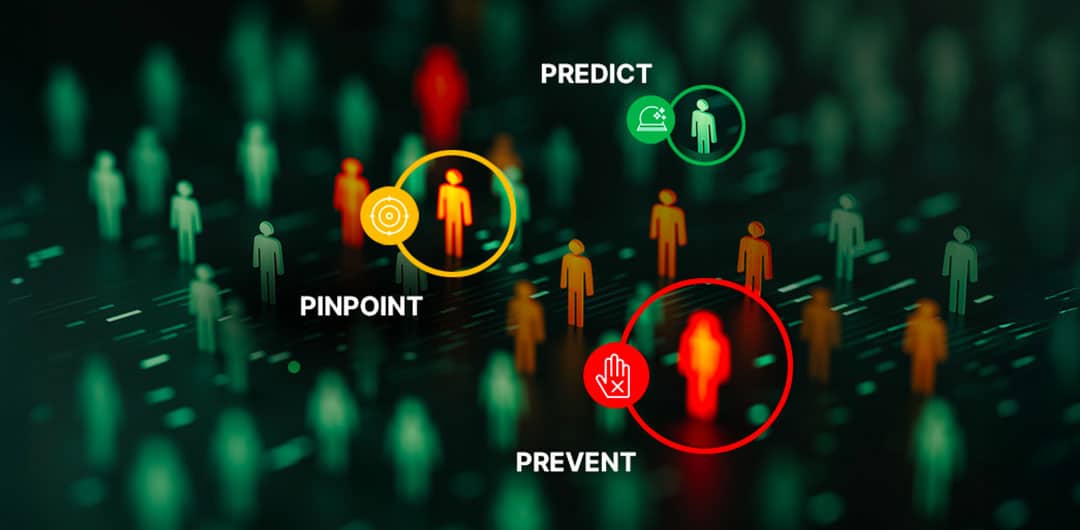
The next generation of IRM platforms will not only detect threats, they’ll help predict them. By layering sentiment analysis, risk scoring, and behavioral intelligence into one system, AI enables a proactive security posture that aligns with business strategy.
AI-powered IRM helps organizations:
- Identify issues before they escalate
- Reduce dwell time from months to days
- Strengthen compliance posture and audit readiness
This is particularly critical in high-risk environments like finance, healthcare, and SaaS, where data exposure and regulatory fines carry outsized impact.
Final Thought
AI is not replacing your security team; it’s enabling them to act with more speed and accuracy. By embedding AI into your IRM strategy, you gain the foresight and context necessary to turn reactive response into proactive protection.
Insider Risk continues to provide a threat to organizations. Speed in detection and response is critical.
Ready to bring AI into your insider risk strategy?
Schedule a demo and see how Veriato helps organizations like yours detect and prevent insider threats before they escalate.
FAQs
Q: What role does AI play in Insider Risk Management?
A: AI enables risk detection based on user behavior, tone, access deviation, and anomalies. It improves detection speed and prioritization.
Q: How does this differ from DLP or SIEM?
A: While DLP and SIEM detect rule-based events, AI-powered IRM provides behavioral context that connects disparate events into actionable insights.
Q: Why is IRM now a cross-functional priority?
A: There is organizational efficiency gained through understanding the stake HR, legal, and privacy teams have in insider risk strategy, which ensures ethical, accurate, and timely responses.
Q: Is AI necessary for mid-sized organizations?
A: Yes. Organizations of all sizes will benefit from AI’s ability to reduce noise, prioritize threats, and scale detection without additional staff.
Insider Risk Management Guide to Behavioral Visibility
Discover how modern Insider Risk Management leverages behavioral visibility, sentiment analysis, and AI-driven risk scoring to strengthen security, compliance, and workforce resilience.
About the author